English
English at St. Anne's Catholic Primary School
English and Writing Lead: Mrs Kemp-Smith
Reading Lead: Mrs Pigot
Phonics Lead: Miss Alba
Intent
Our English curriculum aims to inspire children to be curious, creative and independent learners. The children are engaged by high quality literature during English lessons and have daily opportunities to engage confidently in peer to peer discussion. By valuing and cherishing high quality literature across our school and across our curriculum, our children will shape, draft and publish their writing, resulting in beautiful, well-written work of which they are justifiably proud.
Discussion within the classroom is used as a means of developing metacognition, resulting in the children developing a reflective, critical approach to both reading and writing. We strive to ensure that all children are supported to develop ideas and opinions around literature and are able to articulate themselves with confidence.
DfE, National Curriculum (2014):
The study of English will therefore teach children to speak and write fluently so that they can communicate their ideas and emotions to others, and through their reading and listening, others can communicate with them. Children will have a chance to develop culturally, emotionally, intellectually, socially and spiritually. Literature, especially, will play a key role in such development. Reading will enable children both to acquire knowledge and to build on what they already know.
We intend that the study of English will enable our children to:
- Read easily, fluently and with good understanding.
- Develop the habit of reading widely and often, for both pleasure and information.
- Acquire and use a wide vocabulary.
- Develop an understanding of grammar and knowledge of linguistic conventions for reading, writing and spoken language.
- Write clearly, accurately and coherently, adapting their language and style in and for a range of contexts, purposes and audiences.
- Use discussion in order to learn; they should be able to elaborate and explain clearly their understanding and ideas.
- Become competent in the arts of speaking and listening, making formal presentations, demonstrating to others and participating in debate.
Implementation
Our English curriculum is implemented through the use of rich texts and engaging pupils with a cross-curricular approach. Texts are chosen to link with the topics pupils are learning about and these are used as a springboard to inspire pupils to read and write. We believe that choosing the right context and starting point to engage our children in their learning is vital in fostering a love for reading and writing.
Our English curriculum aims to provide many purposeful opportunities for reading, writing and discussion. We want all of our pupils to be proficient readers, writers, spellers and speakers, who can transfer their English skills to other curriculum subjects and who are prepared for the next steps in their education. Our English lessons develop pupils’ spoken language, reading, writing, grammar and vocabulary, teaching them how to write within specific genres and which structural and language features to include to be successful.
Example texts are used to start this process to enable pupils to use other similar writing as models for their own. Lessons also focus on teaching specific spelling, grammar and punctuation skills to enable our pupils to apply the skills they have been taught to their extended writing and writing across the curriculum. We teach our pupils to speak clearly, to convey their ideas fluently and confidently and to ask questions. Teachers use a wide variety of resources as appropriate to their classes, but also ensure that cross curricular links with concurrent topic work are woven into the programme of study.
Phonics
We follow the Rocket Phonics programme from Reception through to Year 2. Phonics is taught from phase 1 (EYFS) to phase 6 (Year 2). A Phonics screening check takes place at the end of Year 1 as per DfE requirements and results are given to parents.
https://www.risingstars-uk.com/series/rising-stars-reading-planet/phonics-guide/advice-for-parents
Spelling
In key stage 2, the Spelling Shed scheme is used. It has been created following key National Curriculum objectives and will take children through the statutory and non-statutory spelling lists in each age phase. The scheme of work for spelling gives 100% coverage of the National Curriculum including all statutory words and spelling rules. The scheme is broken up into a weekly progression with a Spelling Shed list for each week plus printable activities and resources to aid teaching and learning.
https://www.spellingshed.com/en-us/parents
Reading
Reading in Key Stage 2
At our school, reading is at the heart of learning. We aim to develop confident, fluent readers who not only understand what they read but also develop a genuine love of books and reading.
Accelerated Reader
In Key Stage 2, children use Accelerated Reader to support their reading development. At the beginning of the academic year, children complete a Star Reading Test, which helps identify their current reading level and appropriate book range. Children complete further assessments throughout the year, allowing teachers to closely monitor progress, identify strengths and areas for development, and ensure reading materials remain appropriately challenging.
Accelerated Reader quizzes help teachers assess children's understanding of what they have read, while myON provides access to a wide range of engaging digital texts that children can enjoy both at school and at home.
Master Readers
Children take part in five reading lessons each week following the Master Readers approach. These carefully planned lessons expose children to a wide range of high-quality texts, including fiction, non-fiction and poetry.
During Master Readers lessons, children develop the key reading skills needed to become successful, independent readers. These include:
Retrieving information directly from a text.
Making inferences and justifying ideas using evidence.
Predicting what might happen next.
Exploring the meaning of vocabulary and authorial language choices.
Summarising key ideas and identifying main themes.
Explaining how texts are organised and structured.
Comparing characters, settings, themes and author's viewpoints.
Evaluating and responding thoughtfully to what they have read.
Children are encouraged to discuss texts, explain their thinking and support their answers with evidence, helping them become confident and reflective readers.
Reading at Home
Children should read regularly at home and be read to frequently by an adult throughout their primary years, including in Key Stage 2. Research consistently shows that children who read regularly at home make greater progress in reading, writing, vocabulary development and overall academic achievement.
Reading aloud to children exposes them to a wider range of language and vocabulary than they are likely to encounter independently. It also helps develop comprehension skills, strengthens family relationships and nurtures a lifelong enjoyment of reading.
How Parents and Carers can Support Reading at Home
Evidence suggests that the most effective support comes from making reading an enjoyable, regular part of family life. You can help by:
Listening to your child read little and often, aiming for at least 10–15 minutes each day.
Continuing to read aloud to your child, even when they can read independently.
Talking about books and asking open-ended questions such as:
What do you think the character is feeling?
Why do you think they made that choice?
What might happen next?
What evidence in the text supports your idea?
Discussing new vocabulary and encouraging your child to use unfamiliar words in conversation.
Encouraging your child to re-read favourite books to build fluency and confidence.
Modelling reading yourself so that children see reading as a valued and enjoyable activity.
Visiting local libraries and allowing children to choose books that genuinely interest them.
Celebrating reading achievements and sharing recommendations as a family.
The most important factor is helping children develop positive reading habits and a love of books that will support their learning throughout school and beyond.
Reading Diaries
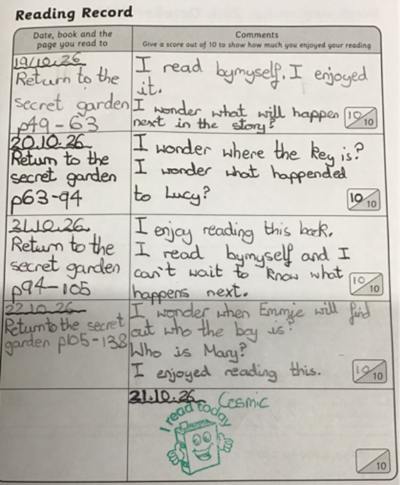
Children are expected to read at home every day and record their reading in their Reading Diary. Regular reading practice helps children develop fluency, comprehension, vocabulary and confidence, enabling them to become successful, lifelong readers. After each reading session, children should record the date, book title, pages read and a comment about their reading. Parents and carers should review and sign the diary weekly to show they have supported and monitored their child's reading at home.
Useful comment sentence stems:
-
My favourite part was...
-
I learned that...
-
I was surprised when...
-
I think the character is feeling... because...
-
The most interesting fact I found out was...
-
This chapter taught me...
-
I predict that...
-
I wonder why...
-
A new word I learned was... which means...
-
This book reminds me of...
-
The author makes me think that...
-
I enjoyed this section because...
-
I was confused by...
-
The most important event was...
-
I would recommend this book because...
We encourage families to make reading a positive part of their daily routine. Even a short period of reading each day can make a significant difference to a child's progress and enjoyment of reading.
Recommended Reads
To support the reading and literacy we do in school, we hope that parents, carers and children will find our suggested reading lists inspiring and helpful when choosing books to read at school and at home. The lists contain a range of high-quality texts suitable for different ages and interests and are designed to encourage children to explore new authors, genres and themes.
Reading Lists by Year Group
|
Year Group |
Autumn 1 |
Autumn 2 |
Spring 1 |
Spring 2 |
Summer 1 |
Summer 2 |
|
Year 3 |
Stone Age Boy |
Wild Life |
Escape from Pompeii |
Charlie and the Chocolate Factory |
The Firework-Maker's Daughter |
The Iron Man |
|
Year 4 |
The Time-Travelling Cat and the Egyptian Goddess |
National Geographic: Volcanoes and Earthquakes |
Escape from Pompeii (Jim Eldridge) |
The Wreck of the Zanzibar |
Oliver Twist |
Christophe's Story |
|
Year 5 |
Cosmic |
Hidden Figures |
The Girl of Ink and Stars |
The Giant's Necklace |
Journey to the River Sea |
Around the World in Eighty Days |
|
Year 6 |
Goodnight Mr Tom |
Goodnight Mr Tom |
Holes |
Holes |
The Explorer |
The Explorer |
Writing
All children from Reception to Year 6 are provided with many opportunities to develop and apply their writing skills across the curriculum. Initially, pupils need to be able to form the letters needed and then be able to express one’s ideas using these letters. Through shared and guided writing opportunities, we equip children to develop the skills of writing clearly and legibly. When the child is confident with these basic skills, they work towards being able to write with a greater sense of purpose and learn to organise their writing according to this purpose. Children are equipped with the necessary tools to do this, being given daily opportunities to focus on spelling and/or grammatical structures.
We develop our pupils writing skills so that they have the stamina and ability to write at length, applying the skills set out in the English National Curriculum. To support children in moving towards independent writing we provide a wide range of activities including the use of film and imagery, music, ICT, modelled, shared and guided writing, peer assessment and discussion. We provide varied and exciting opportunities for writing for purpose, and we encourage pupils to see themselves as authors and poets. We promote the importance of written work by providing a writing purpose and opportunities for children’s writing to be read aloud and listened to by an audience.
Impact
By the time the children leave St Anne’s, we want them to demonstrate high standards of language and literacy. We also want them to be happy, confident learners who have developed a love of reading and writing; equipped with the skills and knowledge necessary for their next stage of learning. We want them to have high aspirations and be confident in the art of speaking and listening, able to use discussion to communicate and further their learning.
- Pupils are motivated by questioning to extend thinking with a balance of talk, listening, exploring and observing.
- Pupils’ books show positive progress in all subjects.
- Lessons are planned to ensure pupils master the content of the planned curriculum.
- Data shows positive progress for all groups of pupils.
- Increasing numbers of pupils achieve expectations in national assessments. Internal data reflects this trend too.
- All pupils learn to read confidently with accuracy and fluency so that they are able to access all areas of the curriculum.
- All pupils develop a love of reading.
- All pupils are able to recall and discuss the subjects they are learning and explain what they remember from lessons they have participated in.
- All pupils develop their knowledge of the world by actively engaging with planned opportunities and experiences, and reading quality texts across the curriculum for information and enjoyment.
- Pupils enjoy learning and are confident communicators who develop a wide vocabulary.
- Quality first teaching and assessment for learning is effective.
In lessons pupils:
- Articulate the intended learning and say what they need to do to achieve it, demonstrating excellent attitudes to learning and self-discipline.
- Evaluate their own progress towards the intended learning and identify next steps.
- Access the intended learning, maintaining active engagement and motivation throughout.
- Learn to read confidently with accuracy and fluency so that they are able to access all areas of the curriculum.
- Develop a love of reading.
- Are able to recall and discuss the subjects they are learning and explain what they remember from lessons they have participated in.
- Develop their knowledge of the world by actively engaging with planned opportunities and experiences, and reading quality texts across the curriculum for information and enjoyment.
- Develop the confidence to access the next stage in their education and are positioned to take advantage of the opportunities presented to them.
- Enjoy learning and are confident communicators who develop a wide vocabulary.
Useful Websites
English Programmes of Study: National Curriculum in England
https://assets.publishing.service.gov.uk/government/uploads/system/uploads/attachment_data/file/335186/PRIMARY_national_curriculum_-_English_220714.pdf
National curriculum in England: Appendix 1 Spelling
https://assets.publishing.service.gov.uk/government/uploads/system/uploads/attachment_data/file/239784/English_Appendix_1_-_Spelling.pdf
National curriculum in England: Appendix 2 Vocabulary Grammar and Punctuation
https://assets.publishing.service.gov.uk/government/uploads/system/uploads/attachment_data/file/335190/English_Appendix_2_-_Vocabulary_grammar_and_punctuation.pdf